one version stays much longer
CJC-1295 Ipamorelin Has a Version That Lasts Days
One version fades about half an hour. A chemical hook keeps the other in blood for days, so growth hormone stays raised longer.
A chemical hook makes one version last for days
The name CJC-1295 Ipamorelin can refer to two CJC-1295 versions. One has a chemical hook called DAC. The hook holds onto albumin, a protein in your blood. That keeps the drug in your body for days and keeps growth hormone raised longer.
You may see the short version sold under another lab name. A blood enzyme breaks it down near half an hour. One version acts for days. The other acts for a short time. That gap may change what happens in your body when either version is joined with ipamorelin. You’ll get the time facts here, without a dose.
The hooked drug stayed in blood for days
The long-lasting CJC-1295 drug carries the chemical hook called DAC. That hook bonds with albumin, a blood protein. Picture a boat tied firmly to a dock. You can compare this hooked version with the short piece that had no hook.
In rats, the hooked drug caused about a 4-fold growth-hormone rise over 2 hours. Scientists still found the drug in blood after 72 hours [5]. In healthy adults, one shot under the skin raised average growth hormone 2- to 10-fold for six days or more. Growth factor 1, a hormone your liver makes to guide cell growth, rose 1.5- to 3-fold for 9–11 days. After more CJC-1295 shots, growth factor 1 remained high as long as 28 days [1]. For you, the hook turns a short action into one lasting days.
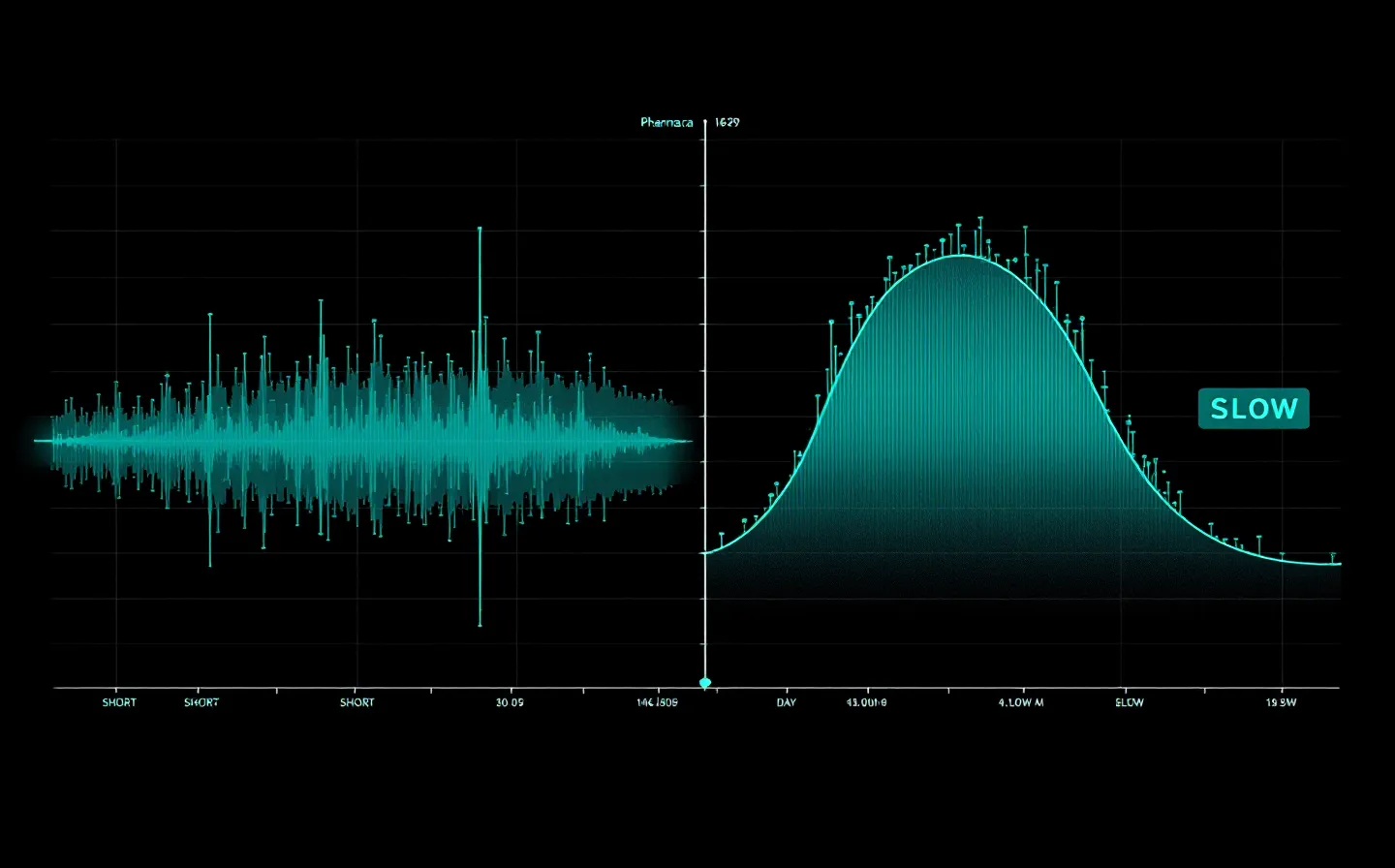
The short version can’t hold onto the blood protein
Take away the hook and you get mod grf 1-29. That lab label means the short CJC-1295 version. It is a changed piece of a hormone your body makes. Without the hook, the drug can’t hold onto albumin. A blood enzyme clears it in about 30 minutes. Other changes protect the drug briefly, but it still fades fast. It doesn’t keep your growth hormone high for days.
Your body normally releases growth hormone in 5–9 bursts each day. The short version acts more like one brief burst. In your blood, the hooked version keeps the hormone raised between those bursts. Neither action proves that a lab-made drug will help you.
Short and long versions create very different timing
Timing changes when CJC-1295 is joined with ipamorelin. Ipamorelin causes one short growth-hormone rise and leaves within hours [2]. With the short version, both drugs act briefly. That timing is closer to the related pair studied in men [3]. With long-lasting CJC-1295, growth hormone stays raised between ipamorelin’s brief rises [1]. You have less research about that match. You can’t assume both versions act alike in your body.
No study has measured the total rise from a set routine. Earlier researchers used brief bursts from both proteins [3]. For you, the short match has closer support, yet it still doesn’t prove a health benefit.
One version takes minutes, while the other takes days
You can use these facts to compare how long each version remains in blood.
- Long-lasting CJC-1295 bonds with albumin, a blood protein. Half the drug clears in about 6–8 days in people. Growth hormone stays high for days. Growth factor 1, a hormone your liver makes to guide cell growth, may stay high for weeks [1][5].
- Short CJC-1295 doesn’t bond with albumin. Half clears in about 30 minutes, so its action is brief.
Neither version has FDA approval. Beyond that, researchers haven’t tested a fixed blend of either version with ipamorelin in a controlled human trial. Chemical weights and record numbers won’t answer your question about whether either version helps or harms you, so they aren’t included here.